Multi-Objective Optimal Power Flow (OPF) for Radial Distribution Grid

Table of contents

  1. Introduction
    1. Test Case
    2. Preliminary test
    3. Objective
  2. Proposed Voltage Control
    1. Description
    2. Simulation
    3. Accuracy Test
    4. Comparing with DC OPF
  3. Sensitivity Analysis
  4. Conclusion

Required modules/Packages

1) Introduction

1. A) Test Case

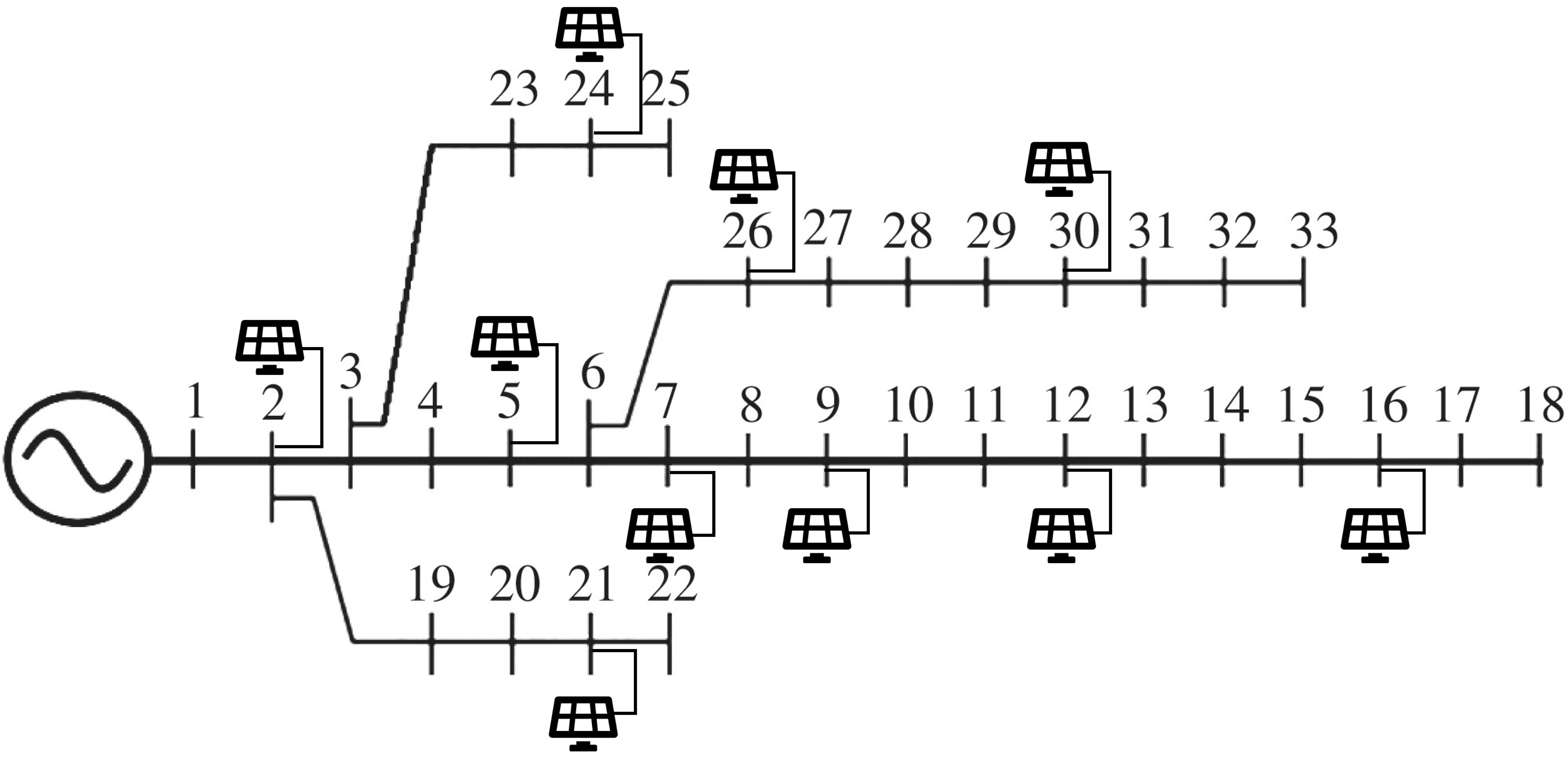
In this study, we use the IEEE 33-bus [1] feeder for the test case. 10 additional 1MW PVs are implented at bus [2, 5, 7, 9, 12, 16, 21, 24, 26, 30], as shown in the figure below.

Ref: [1] Khanh, B.Q. and Hojo, M. (2019), Optimally selecting the location of a multiple of D-statcoms for the improvement of SARFIX due to faults in the IEEE 33-bus distribution system. IEEJ Trans Elec Electron Eng, 14: 1172-1180. https://doi.org/10.1002/tee.22915


1. B) Preliminary test

In the preliminary test, we try to observe the voltage profile at one particular time step. The PVs and loads are configured as follow:

To obeserve the voltage profile, we perform a load flow simulation using a conventional solver called Panda Power [2].

Ref: [2] L. Thurner, A. Scheidler, F. Schäfer et al, pandapower - an Open Source Python Tool for Convenient Modeling, Analysis and Optimization of Electric Power Systems, in IEEE Transactions on Power Systems, vol. 33, no. 6, pp. 6510-6521, Nov. 2018.

To start the test, firstly we need to load the grid data

Create the network data for Panda Power

Run the preliminary load flow with Panda Power

Extract the voltage results

Plot the preliminary voltage profile

As we can see in the figure above, the voltage at certain bus exceed the upper voltage limit (1.05 p.u.). This highlights that a high penetration of PV may lead to overvoltage in the distribution grid.

In order to mitigate the voltage violation, we have to curtail the PVs production. However, the PVs have to be optimally curtailed in order to fully maximize the benefit of local energy production.

1. C) Study Objective

Therefore, the objectives of this study are:

  1. Propose a voltage control solution to maintain grid voltage by curtailing PV production
  2. Compare the proposed controller with other voltage control solution
  3. Perform sensitivity analysis of the proposed controller

2) Proposed Voltage Control / OPF formulation

2. A) Short Description

The proposed voltage control is formulized as an optimal power flow (OPF) problem with second-order conic programming (SOCP). The detailed explanation of the proposed controller can be found on my publication [3].

Ref: [3] M. A. Putratama, R. Rigo-Mariani, V. Debusschere and Y. Besanger, "Parameter Tuning for LV Centralized and Distributed Voltage Control with High PV Production," 2021 IEEE Madrid PowerTech, 2021, pp. 1-6, doi: 10.1109/PowerTech46648.2021.9494802.

Brief formulation

Briefly, the voltage control aims to minimized the grid losses and total PV curtailments, as follow:

$$\large{\min C_{loss} \underbrace{\sum_{(i,j) \in E} \ell_{ij}r_{ij}}_{\text{losses}} + C_{pv} \underbrace{\sum_{b \in B} P^{pv}_b - P^{pv*}_b}_\text{PV curtailments}}$$

Subject to Grid constraints, PV constraints, voltage constraints, and SOCP/Convex relaxation as follow:

$$\large{\ell_{ij} \geq \frac{P_{ij}^2+Q_{ij}^2}{\nu_i}}$$

The relaxation relaxed the original equality branch current equation into an inequality relation.

Additional controller parameters Closs and Cpv are introduced to give additional weights between to objective functions.

Why Convex relaxation?

Because a convex problem is easy to solve and optimality of the soluiton can be guaranteed.

Simulation Process

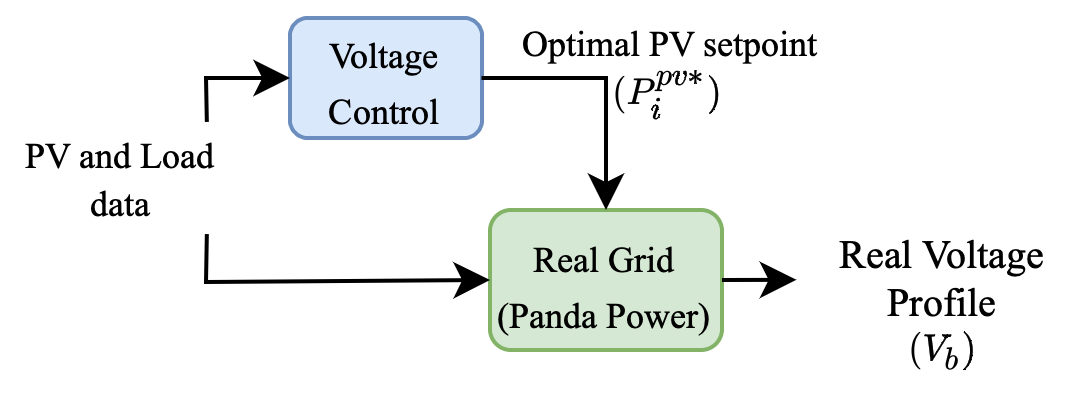
The simulation process is illustrated in the figure below.

  1. The controller uses the deterministic PV and load data as the input.
  2. The controller computes the optimal PV setpoint for the given load and PV profile.
  3. The controller sends the optimal PV setpoints to the "real grid"/Panda Power.
  4. We perform a load flow calculation with Panda Power, to simulate the "real grid", thus voltage can be observed.


2. B) Simulation

Firstly, we configure the controller by setting the following parameters.

Generate the bus and branch data for the controller.

Execute the OPF/Controller:

As illustrated in the previous figure, the output of the controller is the optimal PV setpoints. Alternatively, these setpoints can also be visualized as required PV curtailments:

The PVs at bus 12 and 16 have to be curtailed in order to maintain the grid voltage within the limit. Interestingly, other PVs are not curtailed. This is because bus 12 and bus 16 located in the weak part of the grid.

This situation leads to unfair environment, since The PV owners at bus 12 and 16 will incur economic loss and they will sell fewer energy compared to their neighbors.

Now, let's inject the optimal PV setpoints to the actual grid, by performing load flow with Panda Power. Firstly, we update the network data:

Run the load flow

Extract the voltage results

Let's compare the optimized voltage and the preliminary voltage

The optimized voltage can maintain the voltage just below the limit line!

2. C) Accuracy of the Proposed Controller

The proposed controller is a model-based controller. Internally, the controller mimic/simulate the real grid in order to compute the optimal PV setpoints and it also estimates the resulted voltage profile for the computed setpoints.

Now, we try to compare the voltage estimated by the controller with the actual grid voltage to observe the accuracy of the controller.

We can see that the estimated voltage perfectly match the actual grid voltage. This highlights the high accuracy of the controller and the convex relaxation.

Due to its accuracy, the proposed controller then can also be used as a load flow solver by performing slight modifications:

  1. Take out the 2nd objective (PV curtailment part)
  2. Take out the voltage operating limit
  3. Set the PV as parameters (not variables)

Performing a load flow with the proposed controller leads to faster computational time than the conventional load flow solver:

2. D) Comparison with DC OPF

To further compare, let's compare the proposed controller with DC OPF, which is widely used method to relax an OPF problem.

Now let's run DC OPF:

Update the network with the setpoints obtained from the DC OPF

Run the load flow

Extract the voltage results

To compare the performance, we can first observe the estimated voltage profile from DC OPF with the actual grid voltage

We can clearly see the gap of mismatch between the actual and estimated voltage in DC OPF.

Furthermore, let's compare the PV curtailments between proposed controller and DC OPF:

We can see in the figure above that the inacuraccy of the DC OPF leads to more PV curtailed in bus 12. In real life, this situation will incur more economic loss for the PV owners and useful renewable resources will be wasted.

3. Sensitivity Analysis

The sensitivity analysis aims to observe the performance of the proposed controller based on different configuration of the parameters (Closs and Cpv). To recall, the objective function of the proposed controller is:

$$\large{\min C_{loss} \underbrace{\sum_{(i,j) \in E} \ell_{ij}r_{ij}}_{\text{losses}} + C_{pv} \underbrace{\sum_{b \in B} P^{pv}_b - P^{pv*}_b}_\text{PV curtailments}}$$

The considered parameters value are between [1, 99]

Run the sensitivity analysis

Save the results, so we don't have to re-run sensitivity analysis:

Open the sensitivity analysis results:

Generate matricies for different controller operating regions

The sensitivity analysis obtained 3 different controller regions:

  1. Infeasible: The region where the controller is not feasible/does not work properly due to inacurracy of the convex relaxation.
  2. Losses minimization: The region where the losses minimization is prioritized. The PV production in this case, may be curtailed more in order to minimize the losses.
  3. PV Maximizaton: The region where PV curtailment is minimized (PV production is maximized)

The more details about the regions are explained in my publication [2]

4. Conclusion

We have seen that the proposed voltage control is effective to maintain the grid voltage. It can help us to optimally find the best PV setpoints, in which the overvoltage can be minimized.

The accuracy of the proposed voltage control is significantly higher than the conventional DC OPF, which also highlights that the convex relaxation works properly with the pre-selected parameters.

However, the controller's parameters have to be carefully selected to ensure the controller in the good operating region, as highlighted in the sensitivity analysis.